 Image 1 of 2
 Image 2 of 2
Unlimited edition. 18 x 24 inch, museum-quality poster on matte paper.
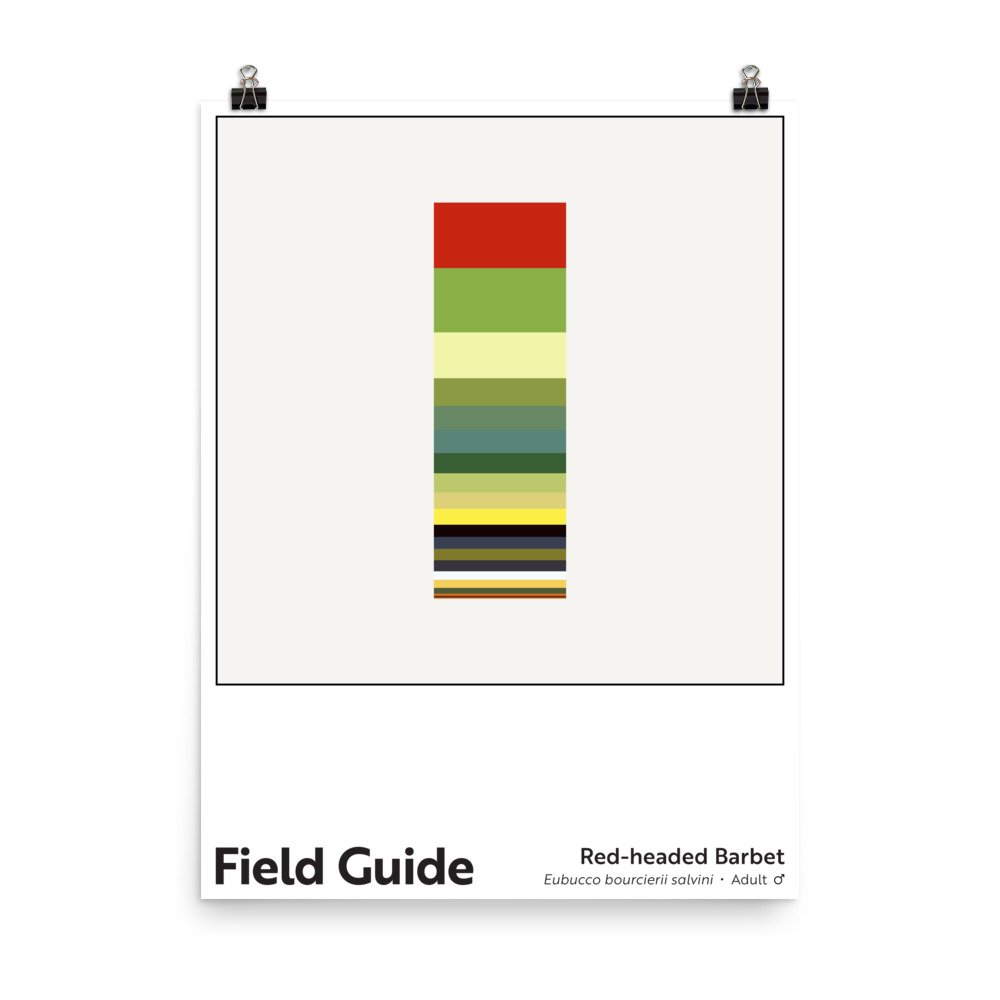
🟢🔴 The male red-headed barbet has a candy apple red hood and a body dominated by apple and olive greens, yellows, and cream. Because it’s small in size, the barbet is something of a Christmas bauble. Looking at the photos of the bird, I expect the the red to occupy more of the color column, but careful measurements bear out, and it’s the largest single color block, but not by much!
This barbet’s range is a broken up into discrete pockets, but generally extends from Costa Rica (where I’ve seen the species) and Panama into Colombia, Ecuador, western Venezuela, and northern Peru. Because the bird’s range is fragmented throughout these countries, there are phenotypic (observable) differences between them and, not surprisingly, recognized subspecies, six of them. This color column is based on the Costa Rican and western Panamanian subspecies, Eubucco bourcierii salvini; compared to its red-headed kin, this barbet has more red and a little less orange – the differences are noticeable, but not dramatic!
No matter where the red-headed barbet is found geographically, though, it’s a bird of montane forests. I was surprised to learn that a flashy bird species with a stable population that resides in countries where birds are often well-studied has not been studied extensively. The Cornell Lab of Ornithology’s entry on the species states: “The diet, foraging behavior, social behavior, and nesting biology have not been studied in detail, and there is no information on topics such as population density, age at first breeding, life span and survivorship, dispersal, or population regulation.” Perhaps this is due to the relative difficulty of locating birds in tropical montane forests? We do know they primarily feed on fruit, but will also glean insects, and we know they feed mostly in the forest canopy or mid-story. Their social interactions aren’t well documented, however, and we don’t know much about their breeding other than their apparent preference for cavity nesting. Hmmmm. Budding ornithologists, if you love Christmas colors and you love birds, maybe this is the species to chase?
Interestingly, these flag birds are the only North American woodpecker species that routinely cover their stored food, generally by using bits of wood. Acorns and beechnuts are commonly cached, but the birds will even catch large grasshoppers and push them, still alive, into tight crevices from which they can’t escape so the woodpecker can return later for “fresh meat.”
Note: These archival poster prints feature rich, appealing colors. I encourage customers to take care in handling them until they are framed/protected for display; the darker colors on the matte paper can be scratched. They ship rolled, so customers need to flatten them before framing (or have their framer do so).
Charitable Sales Model: Whenever one of these poster prints is purchased, a charitable contribution equal to 10% of the print’s cost (or $3.60) is made to a nonprofit working to tackle environmental or social challenges. Read more about my charitable sales model here.
Unlimited edition. 18 x 24 inch, museum-quality poster on matte paper.
🟢🔴 The male red-headed barbet has a candy apple red hood and a body dominated by apple and olive greens, yellows, and cream. Because it’s small in size, the barbet is something of a Christmas bauble. Looking at the photos of the bird, I expect the the red to occupy more of the color column, but careful measurements bear out, and it’s the largest single color block, but not by much!
This barbet’s range is a broken up into discrete pockets, but generally extends from Costa Rica (where I’ve seen the species) and Panama into Colombia, Ecuador, western Venezuela, and northern Peru. Because the bird’s range is fragmented throughout these countries, there are phenotypic (observable) differences between them and, not surprisingly, recognized subspecies, six of them. This color column is based on the Costa Rican and western Panamanian subspecies, Eubucco bourcierii salvini; compared to its red-headed kin, this barbet has more red and a little less orange – the differences are noticeable, but not dramatic!
No matter where the red-headed barbet is found geographically, though, it’s a bird of montane forests. I was surprised to learn that a flashy bird species with a stable population that resides in countries where birds are often well-studied has not been studied extensively. The Cornell Lab of Ornithology’s entry on the species states: “The diet, foraging behavior, social behavior, and nesting biology have not been studied in detail, and there is no information on topics such as population density, age at first breeding, life span and survivorship, dispersal, or population regulation.” Perhaps this is due to the relative difficulty of locating birds in tropical montane forests? We do know they primarily feed on fruit, but will also glean insects, and we know they feed mostly in the forest canopy or mid-story. Their social interactions aren’t well documented, however, and we don’t know much about their breeding other than their apparent preference for cavity nesting. Hmmmm. Budding ornithologists, if you love Christmas colors and you love birds, maybe this is the species to chase?
Interestingly, these flag birds are the only North American woodpecker species that routinely cover their stored food, generally by using bits of wood. Acorns and beechnuts are commonly cached, but the birds will even catch large grasshoppers and push them, still alive, into tight crevices from which they can’t escape so the woodpecker can return later for “fresh meat.”
Note: These archival poster prints feature rich, appealing colors. I encourage customers to take care in handling them until they are framed/protected for display; the darker colors on the matte paper can be scratched. They ship rolled, so customers need to flatten them before framing (or have their framer do so).
Charitable Sales Model: Whenever one of these poster prints is purchased, a charitable contribution equal to 10% of the print’s cost (or $3.60) is made to a nonprofit working to tackle environmental or social challenges. Read more about my charitable sales model here.