 Image 1 of 2
 Image 2 of 2
Unlimited edition. 18 x 24 inch, museum-quality poster on matte paper.
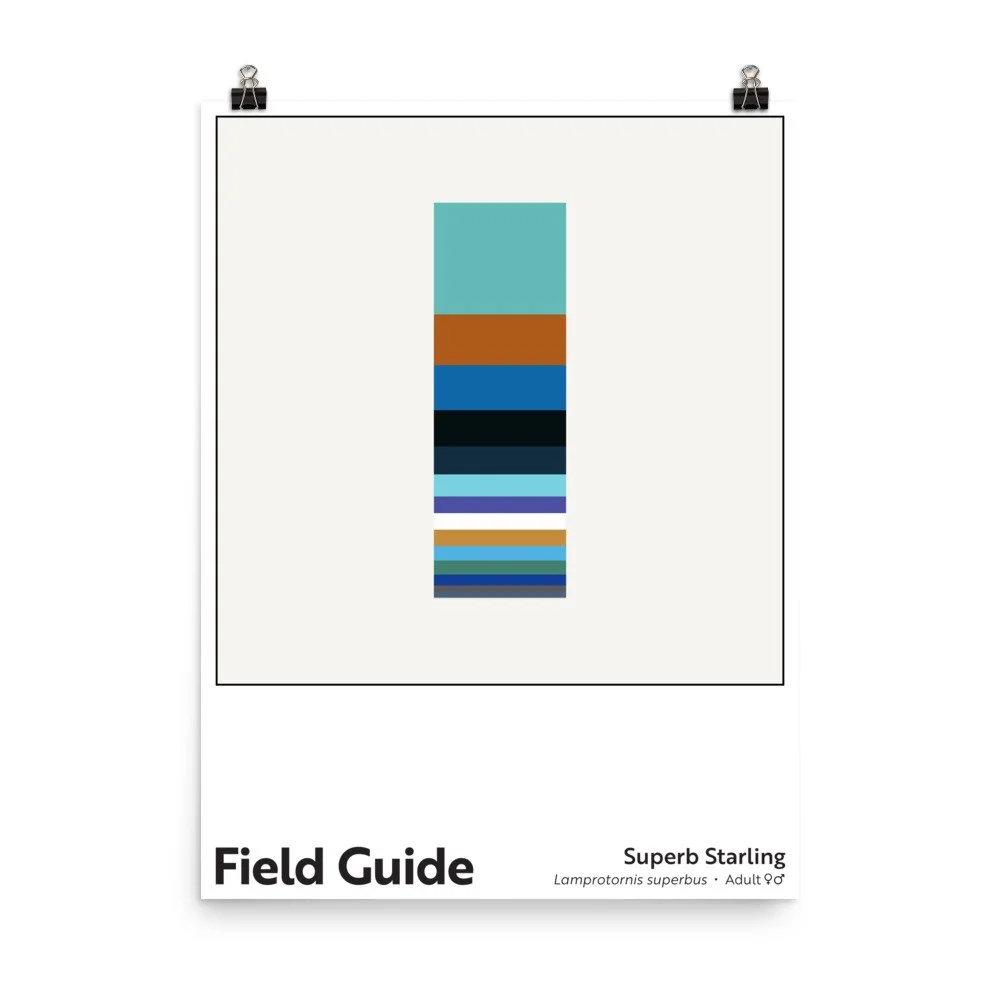
The iridescence of the superb starling’s marvelous technicolor dreamcoat doesn’t translate easily to the color column approach. I seek out each bird’s “neutral” colors for each column’s bands, so the panoply of hues that plays over the plumage in sunlight isn’t well represented. Still, even without the iridescence, the superb starling is an extravagant bird, and this color column reflects that flamboyance.
The superb starling is a bird of eastern Africa’s savanna and open woodlands. Like many starlings, they also do quite well living near human habitation. In flocks of up to a dozen birds, these birds feed primarily on insects – beetles, ants, grasshoppers, and termites feature prominently on the menu – as well as berries and small fruits. Their insect prey are almost always captured on the ground.
This starling species is a cooperative breeder; most superb starling breeding pairs receive help from starlings that aren’t breeding that year. Usually, these helpers are male offspring from previous broods; I think of them as “mannies.” The mannies bring nesting material before the laying occurs, and also feed the young after hatching. Like most sexually monomorphic birds (species in which the male and female look alike), superb starlings are monogamous. However, in flocks with fewer “mannies,” females will solicit males outside their pair bond for extra-pair copulation.
After they mature, superb starlings can elect to remain with their home group or strike out as young emigrants. These birds are often taken in as good breeding stock by a new group, though research suggests there is active conflict between the immigrant bird and the other members of their adoptive home group; this tension exists throughout their lives. In other words, the immigrant starlings experience more strife, but produce more offspring. As Wu-Tang put it, “B.I.R.E.A.M.” (The biological imperative rules everything around me.)
Note: These archival poster prints feature rich, appealing colors. I encourage customers to take care in handling them until they are framed/protected for display; the darker colors on the matte paper can be scratched. They ship rolled, so customers need to flatten them before framing (or have their framer do so).
Charitable Sales Model: Whenever one of these poster prints is purchased, a charitable contribution equal to 10% of the print’s cost (or $3.60) is made to a nonprofit working to tackle environmental or social challenges. Read more about my charitable sales model here.
Unlimited edition. 18 x 24 inch, museum-quality poster on matte paper.
The iridescence of the superb starling’s marvelous technicolor dreamcoat doesn’t translate easily to the color column approach. I seek out each bird’s “neutral” colors for each column’s bands, so the panoply of hues that plays over the plumage in sunlight isn’t well represented. Still, even without the iridescence, the superb starling is an extravagant bird, and this color column reflects that flamboyance.
The superb starling is a bird of eastern Africa’s savanna and open woodlands. Like many starlings, they also do quite well living near human habitation. In flocks of up to a dozen birds, these birds feed primarily on insects – beetles, ants, grasshoppers, and termites feature prominently on the menu – as well as berries and small fruits. Their insect prey are almost always captured on the ground.
This starling species is a cooperative breeder; most superb starling breeding pairs receive help from starlings that aren’t breeding that year. Usually, these helpers are male offspring from previous broods; I think of them as “mannies.” The mannies bring nesting material before the laying occurs, and also feed the young after hatching. Like most sexually monomorphic birds (species in which the male and female look alike), superb starlings are monogamous. However, in flocks with fewer “mannies,” females will solicit males outside their pair bond for extra-pair copulation.
After they mature, superb starlings can elect to remain with their home group or strike out as young emigrants. These birds are often taken in as good breeding stock by a new group, though research suggests there is active conflict between the immigrant bird and the other members of their adoptive home group; this tension exists throughout their lives. In other words, the immigrant starlings experience more strife, but produce more offspring. As Wu-Tang put it, “B.I.R.E.A.M.” (The biological imperative rules everything around me.)
Note: These archival poster prints feature rich, appealing colors. I encourage customers to take care in handling them until they are framed/protected for display; the darker colors on the matte paper can be scratched. They ship rolled, so customers need to flatten them before framing (or have their framer do so).
Charitable Sales Model: Whenever one of these poster prints is purchased, a charitable contribution equal to 10% of the print’s cost (or $3.60) is made to a nonprofit working to tackle environmental or social challenges. Read more about my charitable sales model here.